| Page 1 of 1 |
|

|
|
|
| Member Price: $ 100.00 |
| Non-Member Price: $ 450.00 |
|
| NRMCA's Green-Star Certification |
|
 Add to Cart
|
|
|
|

|
|
|
| Member Price: $ 19.00 |
| Non-Member Price: $ 29.00 |
|
| To support the QC initiative, NRMCA's Pervious Concrete Technical Committee developed a series of Pervious Concrete Construction Checklists for contractors and ready mix suppliers. This publication provides forms and checklists that can be useful to the pervious concrete contractors and concrete suppliers on projects. Certified pervious concrete contractors or other individuals should use these forms and checklists and modify them as appropriate to local practice and to specific projects. |
|
|
Add to Cart
|
|
|
|

|
|
|
| Member Price: $ 111.75 |
| Non-Member Price: $ 179.00 |
|
| Porous Pavements is the first comprehensive "encyclopedia" of porous pavement materials. The book begins with five chapters that lay a foundation for all porous pavement materials and applications, introducing the types of materials and arrangements, their roles in the urban environment, and the principles of pavement structure, hydrology, and rooting space. The following nine chapters outline the costs, maintenance requirements, advantages and disadvantages for different applications, installation methods, sources of standard specifications, and performance levels for each family of porous pavement materials. Porous Pavements gives responsible practitioners a complete toolbox from which to select the appropriate material for site-specific conditions, providing a "green" alternative to impervious pavements. 600 pgs. 2005. |
|
|
Add to Cart
|
|
|
|
|
|
|
|
| Member Price: $ 100.00 |
| Non-Member Price: $ 200.00 |
|
|
|
|
Add to Cart
|
|
|
|

|
|
|
| Member Price: $ 24.00 |
| Non-Member Price: $ 40.00 |
|
| The Checklist was created by NRMCA as a service to its members to provide a tool for measuring the extent of their environmental compliance at ready mixed concrete plants. The purpose of the Checklist is to provide a convenient tool to help ready mixed concrete producers evaluate their facilities to determine the extent to which they are operating in an environmentally sound manner and complying with potentially applicable environmental regulations and statutes. 35 pgs. #2PENVCK
|
|
|
Add to Cart
|
|
|
|

|
|
|
| Member Price: $ 75.00 |
| Non-Member Price: $ 350.00 |
|
| With more than 250 pages, more than 125 full color images and input from nearly all the major ready mixed concrete companies in the US this document presents the environmental issues that surround the manufacture of ready mixed concrete. The document describes best industry practices for water management, air quality management, admixture, chemical and fuel storage issues, noise management, hazardous waste management, best management practice for fleet maintenance shops, plant aesthetics, plant closures, environmental security and sustainability issues. The publication also describes the organizational makeup of regulatory bodies (Environmental Protection Agency and state and local Environmental Departments) that govern the ready mixed concrete industry and describes agency inspection and tips for preparation of EPA audits. |
|
|
Add to Cart
|
|
|
|
|
|
|
| Member Price: $ 23.00 |
| Non-Member Price: $ 27.00 |
|
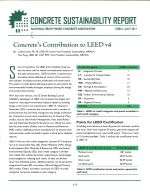
| (Sold in Pkgs. of 20) Can Also be Downloaded after purchase. CSR11 provides a detailed description of how concrete can contribute towards LEED certification. Because of concrete's versatility there are many applications where concrete can be used in a building project, from foundation and superstructure to sidewalks and parking lots. That makes concrete unique in that it can contribute to every credit category in LEED v4. This new CSR report provides suggestions for earning LEED v4 points through the use of ready mixed concrete products. Examples of how concrete can be used to influence points in LEED are presented and a table summarizing how concrete contributes to each credit is provided. 8 pages. This report can also be downloaded after purchase. |
|
|
Add to Cart
|
|
|
|

|
|
|
| Member Price: $ 0.00 |
| Non-Member Price: $ 0.00 |
|
| Free Download Concrete Sustainability Reports (CSR) are technical publications that discuss various sustainability related topics. They are intended to provide a summary of complex topics to help design professionals and concrete industry professionals utilize concrete sustainably. CSR10 provides an overview of the Architecture 2030 Challenge to reduce the overall carbon footprint of the built environment by asking architects to design buildings to be carbon neutral by 2030. Additionally, the program challenges architects to specify products that are working to reduce their carbon footprint by 50% by 2030. This documents what the concrete industry is doing to help meet these challenges and how concrete products provide solutions to a low carbon future. 2 pages. |
|
|
Add to Cart
|
|
|
|

|
|
|
| Member Price: $ 0.00 |
| Non-Member Price: $ 0.00 |
|
| Free Download Concrete Sustainability Reports (CSR) are technical publications that discuss various sustainability related topics. They are intended to provide a summary of complex topics to help design professionals and concrete industry professionals utilize concrete sustainably. CSR09 describes how research shows that on warm summer days, the temperature in large cities can be significantly hotter than surrounding rural areas, mainly due to dark colored roofing and pavements that absorb most of the sunlight that falls on them and heating the surrounding air. This increase in air and surface temperatures results increased energy demand for buildings, increased greenhouse gas emissions, increased air pollution, reduced human health and reduced water quality. Because of concrete's light color and high reflectivity, using concrete for paved surfaces, along with roofing and cladding for buildings, can help reduce urban heat islands. 8 pages. |
|
|
Add to Cart
|
|
|
|

|
|
|
| Member Price: $ 0.00 |
| Non-Member Price: $ 0.00 |
|
| Free Download "MIT Research: Effects of Inflation and Volatility on Construction Alternatives" Concrete Sustainability Reports (CSR) are technical publications that discuss various sustainability related topics. They are intended to provide a summary of complex topics to help design professionals and concrete industry professionals utilize concrete sustainably. CSR08 describes how Life-Cycle Cost Analysis (LCCA) is used to determine the most cost effective design alternative for assets such as buildings, roads and other infrastructure. Recent research at the MIT examined historical data on real prices and found that the assumption of constant real costs is inconsistent with historical experience. MIT recommendations include accounting for differences in inflation among materials and the general rate of inflation by using an appropriate escalation rates. 2 pages. |
|
|
Add to Cart
|
|
|
|

|
|
|
| Member Price: $ 0.00 |
| Non-Member Price: $ 0.00 |
|
| Free Download "CSR07 MIT Research: Life Cycle Assessment of Concrete Pavements" Concrete Sustainability Reports (CSR) are technical publications that discuss various sustainability related topics. They are intended to provide a summary of complex topics to help design professionals and concrete industry professionals utilize concrete sustainably. CSR07 provides a summary of the Life Cycle Assessment (LCA) results from research conducted at the MIT Concrete Sustainability Hub on concrete pavements. The research provides environmental impacts for a variety of concrete pavements ranging from rural low-volume roads to urban interstate highways. It also provides potential methodologies for reducing environmental impacts, including using mechanistic design procedures, increasing fly ash content in concrete, increasing the reflectivity of concrete and reducing roughness, among other suggestions. 2 pages |
|
|
Add to Cart
|
|
|
|

|
|
|
| Member Price: $ 0.00 |
| Non-Member Price: $ 0.00 |
|
| Free Download "MIT Research: Life Cycle Assessment of Residential Buildings" Concrete Sustainability Reports (CSR) are technical publications that discuss various sustainability related topics. They are intended to provide a summary of complex topics to help design professionals and concrete industry professionals utilize concrete sustainably. CSR06 provides a summary of the Life Cycle Assessment (LCA) results from research conducted at the MIT Concrete Sustainability Hub on residential buildings. The results show that environmental impacts single- and multi-family residential concrete buildings are lower than similar wood buildings over a 60-year life. 2 pages. |
|
|
Add to Cart
|
|
|
|

|
|
|
| Member Price: $ 0.00 |
| Non-Member Price: $ 0.00 |
|
| Free Download "MIT Research: Life Cycle Assessment of Commercial Buildings" Concrete Sustainability Reports (CSR) are technical publications that discuss various sustainability related topics. They are intended to provide a summary of complex topics to help design professionals and concrete industry professionals utilize concrete sustainably. CSR05 provides a summary of the Life Cycle Assessment (LCA) results from research conducted at the MIT Concrete Sustainability Hub on commercial buildings. The results show that the environmental impacts of concrete buildings are lower than steel buildings over a 60-year life. 2 pages. |
|
|
Add to Cart
|
|
|
|

|
|
|
| Member Price: $ 0.00 |
| Non-Member Price: $ 0.00 |
|
| Free Download CSR04 details how Life Cycle Assessment (LCA) is increasingly being used to evaluate structures and building products for environmental performance. It provides a review of new and existing research comparing the environmental life cycle performance of concrete and competing building materials. It also provides a results of LCA research at the MIT Concrete Sustainability Hub. 12 pages. |
|
|
Add to Cart
|
|
|
|

|
|
|
| Member Price: $ 23.00 |
| Non-Member Price: $ 27.00 |
|
| (Sold in Pkgs. of 20) CSR03 outlines how concrete pavements can help reduce the overall environmental impact of our roadway infrastructure. Research studies demonstrating concrete's life cycle advantages over asphalt are presented including reduced fuel consumption, reduced embodied energy and global warming potential. Concrete's ability to reduce urban heat islands and minimize lighting requirements is discussed. 8 pages. This report can also be downloaded after purchase. |
|
|
Add to Cart
|
|
|
|

|
|
|
| Member Price: $ 23.00 |
| Non-Member Price: $ 27.00 |
|
| (Sold in Pkgs. of 20) CSR02 outlines some general statistics on sources of carbon dioxide relative to that attributed to concrete in various phases of its life cycle. It reports on research studies that have quantified the impact of construction materials on energy and CO2 emissions in the production and operational phase of building and transportation infrastructure. The reports indicate that for the most part, concrete stacks up well in comparison to other building materials such as steel, wood and asphalt. 8 pages. This report can also be downloaded after purchase. |
|
|
Add to Cart
|
|
|
|

|
|
|
| Member Price: $ 23.00 |
| Non-Member Price: $ 27.00 |
|
| (Sold in Pkgs. of 20) The first in the series, CSR01 provides a brief description of the LEED 2009 green building rating system and how concrete can contribute within each credit category. Examples of how concrete can be used to influence points in LEED are presented and a table summarizing how concrete contributes to each credit is provided. 8 pages. This report can also be downloaded after purchase. |
|
|
Add to Cart
|
|
|
|

|
|
|
| Member Price: $ 0.00 |
| Non-Member Price: $ 0.00 |
|
| This publication was written by the National Ready Mixed Concrete Association to help its
members understand the complexities of climate change and the greenhouse effect. NRMCA and
its members are dedicated to continuous environmental improvement through product and
process innovation. This publication provides a brief overview of the concrete industry’s role in
minimizing environmental impact related to carbon dioxide emissions. 2PCO2 |
|
|
Add to Cart
|
|
|
| Page 1 of 1 |